Last updated Nov. 15, 2021.
In his effort to clean up the city, clamp down on crime and vice, mayor Jean Drapeau managed to push by-law #2223 prohibiting pinball machines in public spaces as of May 1st, 1955. They were considered gambling machines and corrupted youth. By-law #2229 a few days later clarified the definition of what these machines were, covering pinballs, bingos and bagatelles. It was repealed in 1977 with by-law #5156, and there was also Bill C-71 at the federal level. Even then, pinball was restricted to those at least 18 years old, and in amusement halls, which had a specific definition. In 2016 the North Star machine à piastres bar opened with 10 pinball machines, and in 2017 the law was officially off the books, making the way for barcades in the city.
So here are some movies showing what Montreal arcades looked like in the days without pinball. Most of these were found on Saint Lawrence boulevard A.K.A. The Main, now labelled as Boulevard Saint-Laurent, a bit South of Saint Catherine Street where the Montreal Pool Room, Playland restaurant, Frites Dorées (Silver Amusements), Midway Tavern, Crystal Palace Theatre, the adult Eve Theatre, and a few billiard halls were found. Formerly this area was part of the Red-light district, home to cabarets, gambling, illicit taverns and prostitution, but that was all cleaned up by the early 60s.
Ladies And Gentlemen... Mr. Leonard Cohen (Canada, 1965)
Directed by Donald Brittain & Don Owen, and can be watched for free on the NFB website.There's a brief snippet around 39 minutes in of Leonard Cohen in an arcade. One can see the address in the window, which is 1204 Saint Lawrence boulevard. It was listed in Lovell's 1964 Annual as the Playland Restaurant, formerly Main Gameland Amusements which opened about 1957, and then the place was vacant by '65-66.
Most of the games are too hard to make out given what we can see of the row of machines, but from left to right : Champion Baseball (Genco, 1955) bat game, unknown, Deluxe Shooting Gallery (Midway, 1961), and a few more unknowns...

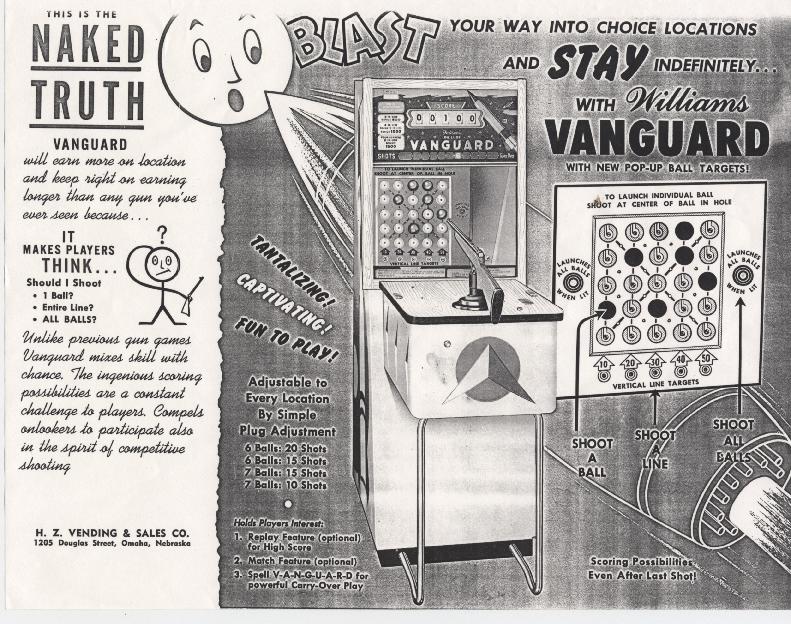
There's a quick sequence wherein Cohen's playing a rifle game called Bonus Gun (United, 1955), and to the left of him is a Vanguard (Williams 1959), a gun game "that pops rubber balls into the air completing bingo style patterns"...

La semaine dernière pas loin du pont (Canada, 1966)
("Last week not far from the bridge") A short film directed by Guy Bergeron. It can be watched on the imdb website. It's in French, but there's actually very little dialog.Some of the action takes place in a snack bar at the address 1951 de Montigny East (which later became de Maisonneuve East), corner of Dorion street, very close to the titular bridge, i.e. the Jacques-Cartier, which crosses the Saint Lawrence river and joins the island of Montreal to the South Shore.
Here we can spot a United Avalon shuffle alley bowler (United Amusement Co., 1962), a 1962 World Series (Williams, 1962) baseball / bat game, and a Circus Rifle Gallery (Genco, 1957)...


There's also an AMI JCI–100 (AMI, 1958) jukebox which we see when a fight breaks out, as well as the front end of the shuffle alley...

Montreal Main (Canada, 1974)
Director: Frank Vitale, starring: Frank Vitale, Allan Moyle, Stephen Lack, Peter Brawley...Allan "Bozo" Moyle would go on to direct The Rubber Gun (1977) featuring several of the same people, and later wrote and directed Pump Up The Volume (1990).
There are a couple of scenes shot in the Frites dorées / Silver Amusements arcade/restaurant at 1212 Saint Lawrence blvd., probably in 1973. Steamed hot dogs, fries and amusement machines like baseball / bat games, hockey, rifle / gun games, driving games, fortune/horoscope, crane, photomat, etc.
Frites Dorées / Silver Amusements existed from about 1951 to the mid-80s when the place became New Frites Dorées (and I guess got rid of the arcade machines). Then about 2008, that whole section on the West side with the exception of strip/dance club Café Cléopâtre got knocked down to make way for the Carré Saint-Laurent development project, although the Montreal Pool Room moved across the street.
The gang enters the place. There's the Frites dorées sign on top, Silver Amusements painted on the windows, and FRITES DOREES inlaid on the sidewalk...

As they enter, we can spot a Vitalizer "Foot Ease" Electricity Circulation Stimulator Floor Machine (Exhibit Supply Co., c. 1941), a couple of gumball machines no doubt made in Canada by Beaver Machine Corp., and a Solar Horoscope and Forecast (Peerless Vending, 1950s?) "grandma" type fortune teller machine...

The scene is shot hand-held and moves around a lot. Moyle plays a Drag Races (Allied Leisure, 1971) driving game and barely visible to the left of him is a Drive-Mobile (International Mutoscope, 1941) and two more movie viewers [not seen in this particular screen capture] which can be better seen in the next movie, Vie d'ange, detailed later in this post...

The film's writer/director and main character, Frank Vitale in front of the Solar Horoscope (Peerless Vending, 1950s?)...

Bozo with a general view with a row of rifle games etc...

Here we can see a bit of a RoadRunner (Bally, 1971) electro-mechanical driving / racing game and a
Texas Ranger Gatling Gun (Chicago Coin, 1963) while Brawley plays a S.A.M.I. (Midway, 1970)...


Here we see Brawley playing a Twin Rifle (Chicago Coin, 1971) and to the left is a Desert Fox (Milwaukee Coin Industries, 1976) shooter videogame...

Here's another angle of the Twin Rifle, with Bozo playing, and an unknown fortune teller / horoscope machine in the corner to the right...

Brawley is playing a hockey game with the boy and we can spot a couple of baseball bat games, specifically Hit and Run Base-Ball (Williams, 1970) and Fast Ball (Williams, 1969), plus a couple of other arcade games, including a Target UFO on the extreme right (which we will see better later on)...

Here's a look at the hockey game I could not identify. One can piece together "Stadium" printed on it, and it has solid 3D, not thin metal 2D players and a little ball instead of a puck. The closest I could find is something like Hockey Champ by Chicago Coin, 1968, but that's not it.

Behind Moyle we can spot more baseballs (from left to right)... Action Baseball (Williams, 1971), Short-Stop or Deluxe Short-Stop (Williams, 1958) and a Bulls Eye Baseball (Chicago Coin, 1967)...

In another scene shot in the same place, the boy Johnny and his friend are accosted by an unsavory character, and we can spot, from left to right : something unknown, a Sea Devil (Midway, 1970) submarine game, an Unscramble (Allied Leisure, 1969) which is "an early Trivia style game using 8mm film on an endless loop", and some other unknown game...

In another scene, the boy is playing a Dog Fight (Midway, 1968) rifle game. To the left is a Target UFO (Made in England by Alca Electronics Ltd., 1969, early 70s?), the Twin Rifle in the back seen earlier, and others...

There's another scene shot in a dépanneur (small corner store, like a non-chain 7-11) with Bozo and Stephen Lack where we can spot a bat game Deluxe Pinch-Hitter (Williams, 1959) on the right with the coin door painted red, and a portable TV set sitting on it...

Vie d'ange (Canada, 1979)
Director: Pierre Harel, starring: Paule Baillargeon, Pierre Harel, Jean-Guy Moreau...Shot in 1974, but only released 5 years later. Probably one of the craziest & most outrageous Canadian films ever made. Harel joined the Quebecois blues-rock group Offenbach early in their career, convincing them to sing in Quebecois French, writing one of their biggest tunes, "Câline de blues", and later founded the Quebec rock group Corbeau in 1977.
There's a scene shot at Frites dorées / Silver Amusements, about a year after Montreal Main, and a few of the same machines are still there!
From left to right, this bunch of machines were also spotted in Montreal Main, like the unknown fortune teller, a 3D Movies (Capitol Projector Corp, 1950s), two Pin-Up Movies mutoscopes (Capitol Projector Corp., 1947) or the reissued Midget Movie Theater (Exhibit Supply, 1962) , and a Drive-Mobile (International Mutoscope, 1941)...

Paule Baillargeon as "Star Morgan", still dressed in her stage performance costume from an earlier scene, plays the Drive-Mobile (International Mutoscope, 1941), with Harel as "Elvus" looking on...

Different angle... one can see a Circus Rifle Gallery (Genco, 1957) rifle game and others to the right...

On the left, a Drive Master (Chicago Coin, 1969), then there's the row of machines described above, and on the right, a woman leads "Wonder" to a rifle game...

Which is the Circus Rifle Gallery (Genco, 1957) seen partially before...

The couple running out of Silver Amusements onto The Main to catch a cab...

Ti-Mine, Bernie pis la gang (Canada, 1976)
Director: Marcel Carrière, starring Marcel Sabourin, Jean Lapointe, Rita Lafontaine, Guy L'Ecuyer...The movie can be watched on the NFB's website, or youtube, although it is in French, with no subtitles.
There's a scene in a snack bar with a few pool tables in the back. We can spot a Base Hit (Williams, 1967) baseball game. This was at 4250 St-Denis, listed in Lovell's 1973-74 annual as City Billiard Hall.


Strange Shadows in an Empty Room (Canada, 1976)
Original title: Una Magnum Special per Tony Saitta
Director: Alberto De Martino, starring: Stuart Whitman, John Saxon, Martin Landau, Carole Laure, Tisa Farrow...
There's a scene in the Gare Central (Montreal's central train station) where the main character (Saitta) finds a key to a locker and hopes it will hold a clue to the murder case he's trying to solve. BTW, the lockers are gone... they were removed after a pipe bomb explosion in September 1984. It was in a locker and killed 3 people and injured 30 more.

In order from furthest from the camera to closest, we can spot the following :
1. A photo booth
2. A guy playing Upper Deck (Williams, 1973) pitch & bat baseball game
3. A guy playing a Super Flipper (Chicago Coin, 1975) which was a video game disguised as a pinball machine. It was pinball on a screen, but with real flipper buttons, ball shooter and housed in a pinball cabinet.
4. an unidentified arcade game with a dark cabinet.
5. an unidentified arcade game whose cabinet is bluish on the side.
6. A guy playing Speed King (Chicago Coin, 1970)
We can also see the butt of a rifle on the extreme right.
As usual, Saitta gets into a fight when he tries to open the locker. We can spot a bit more of the photo booth, and of the Upper Deck cabinet, the Super Flipper, and a bit of the dark arcade game cabinet (but alas, not quite enough to help identify it)...

As people go flying from punches, we can spot some other machines...

1. On the left is the bottom of the Speed King seen before
2. There's enough of the cabinet of the rifle game to identify it, which is a Haunted House (Midway, 1972).
3. Wheels (Midway, 1975) racing game
4. Twin Racer (Kee Games, 1974) which was a clone of Atari's Gran Trak 20.


1. Wheels (Midway, 1975) racing game (top photo only)
2. Twin Racer (Kee Games, 1974) which was a clone of Atari's Gran Trak 20.
3. Speed Burners (Allied Leisure, 1975), another 2-player racing game.
First published Dec. 31, 2018, last updated Nov. 15, 2021.